
January 25, 2022

Privacy glass vs Aftermarket tint

Author

admin

Update First Last in Content -> Business Text -> First Last field

Date

January 25, 2022

Share

A common misconception with the purchase of a new car is that the “tinted” windows will provide you and your car’s interior from damaging UV rays.

This glass is typically dyed glass and provides only privacy.  Solar glass is a step up from the clear automotive glass and has visible light transmission (VLT) varying from as low as the federal limit of 70% VLT up to 88% VLT (which is clear auto glass). Most automotive solar glass ranges 74-84% these days with UV rejection not much over 40% unless it is factory privacy glass, which has UV rejection as high as the 60-percentile range. Some cars, trucks, and sport utility vehicles come from the manufacturer with glass that has been darkened using an electrical process called “deep dipping”. This “factory tinted” glass is a dark shade but does not protect the interior of your car from the sun’s heat or damaging UV rays as well as aftermarket window tinting.

In other words, “factory tint” means the dye is in the glass, it can never be removed. “Aftermarket tint” is a transparent paper with an adhesive side that bonds to the glass, it can be removed.

Window films also reject solar energy, decreasing a vehicle’s interior temperature, reducing the need for air conditioning, and cutting glare.

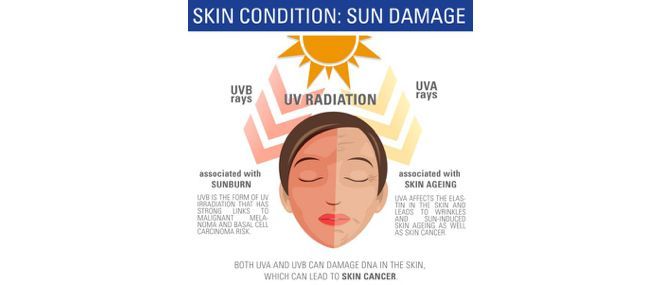
Diagram showing sun damage. Half of a face is sunburned, other half shows signs of aging. Labels show effects of UVA/UVB rays.
By admin January 27, 2022
“The benefits of installing window film go beyond protecting one’s skin and household items, as it also can reduce energy costs.” While it’s understood that taking sun safety precautions is important outside, few people realize they can sustain sun damage indoors, too. While both ultraviolet A (UVA) and ultraviolet B (UVB) radiation from the sun can […] The post Window Film: Sun protection for your health and your home appeared first on South Bay Tinting.
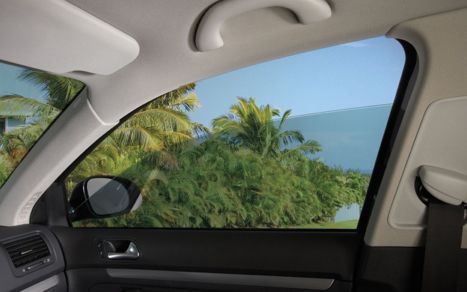
Interior car view, looking out tinted window at tropical landscape with palm trees and water.
By admin January 6, 2022
Crystalline line rejects 99.9 percent of UV radiation and 90 to 97 percent of infrared radiation. While window tint is nothing new, 3M’s Crystalline films are several shades lighter than your average window tint — almost clear, in fact — and are claimed to reflect just as much energy if not more. According to Jon […] The post Block Heat and UV Rays without dark tint appeared first on South Bay Tinting.